Information:
Support for Windows 10 devices encrypted with SecureDoc and upgrading to Windows 10 Threshold 2 and Redstone 1 will be limited to specific scenarios as listed below.
Encryption Type | Windows OS Upgrade Method | Supported/Unsupported |
Hardware encryption (SED/OPAL drives managed by SecureDoc) | 1. System Update via Windows Control Panel
| Both methods are supported |
Software encryption with SecureDoc | Methods:
| Method 1: Not Supported |
Product version affected:
SD 7.1 and later versions
Environment (OS/hardware/software):
Windows 10 upgrade to TH2 or RS1 update
Workaround:
Method 1:
To upgrade a Windows 10 devices to Windows 10 TH2 or RS1 while the device is encrypted using SecureDoc software encryption, please decrypt the device prior to upgrade and then re-encrypt it after the upgrade is complete.
Method 2:
How to Create a Windows 10 custom ISO DVD injected with SD 7.1 kernel drivers to prepare for OS upgrade
Upon OS upgrade, there are 3 options:
a. Keep personal files, apps and Windows settings (Recommended)
- If this option is selected, once the OS upgrade is complete, SecureDoc will be able to function and communicate back to SES server (if managed version is used) without addition steps.
b. Keep personal files only
- SecureDoc will need to be reinstalled after OS upgrade.
c. Nothing
- SecureDoc will need to be reinstalled after OS upgrade.
Procedures on how to inject the SD kernel drivers into the Windows 10 installation media:
1. Download and install Visual Studio 2015 products:
https://www.visualstudio.com/products/vs-2015-product-editions
2. Download Windows Kits and Tools for Windows 10
https://msdn.microsoft.com/en-us/windows/hardware/dn913721.aspx
3. Please contact our Customer Support for the SDPE Tool
SD 7.1 & 7.1 SR1: (SDPETool_71.zip) https://fileshare.winmagic.com/link/6V0IuvZh9fvdSdgChlvpmt
Ensure correct 32 or 64 bit drivers are applied to your OS image
4. Download the OSCDIMG tool to be use in step 12
http://www.deploymywindows.com/2014/11/create-bootable-iso-using-oscdimg-tool.html
5. Create the following 3 folders:
C:\temp\Mount
C:\temp\mountpe
C:\temp\iso (this is the folder where the ISO will be extracted to)
6. Extract the Windows 10 (build 1511) ISO file into the C:\temp\iso\W10x64)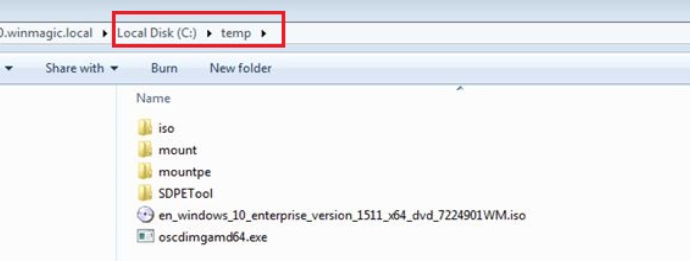
7. Using SDPETool to inject SD kernel drivers into install.wim with the following commands: (~4 min)
C:\temp\SDPETool>SDPETool_X64.exe -a 1 -e win7 -p amd64 –w c:\temp\iso\sources\install.wim -t sys -m c:\temp\mount -i 1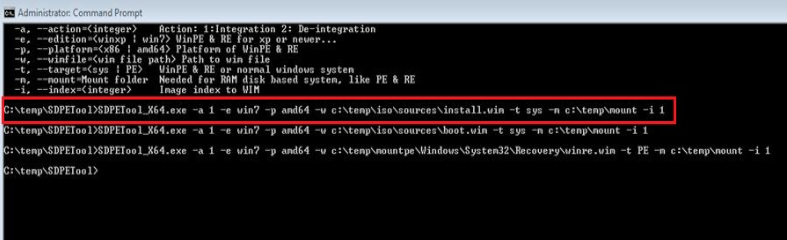
8. Using SDPETool to inject SD kernel drivers into boot.wim (~2-3 min)
C:\temp\SDPETool>SDPETool_X64.exe -a 1 -e win7 -p amd64 -w C:\temp\iso\sources\boot.wim -t sys -m c:\temp\mount -i 1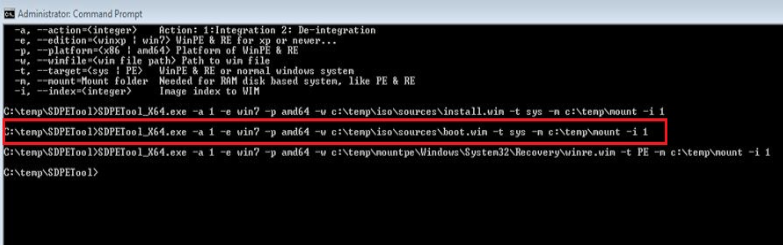
9. Using imagex to mount the install.wim file to a temporary folder
C:\Program Files (x86)\Windows Kits\10\Tools\bin\i386>imagex.exe /mountrw C:\temp\iso\sources\install.wim 1 c:\temp\mountpe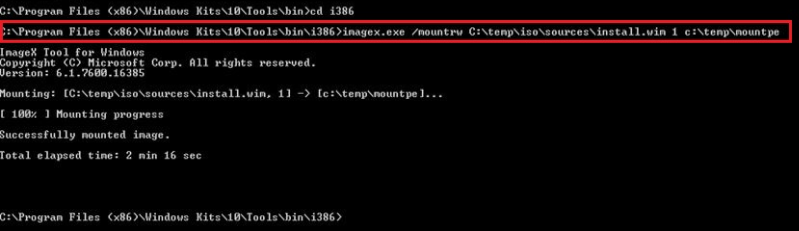
Expected output of ImageX tool for Windows below:
ImageX Tool for Windows
Copyright (C) Microsoft Corp. All rights reserved.
Version: 10.0.10011.0
Mounting: [c:\CustomISO\W10x64\sources\install.wim, 1] -> [c:\temp\mountpe]...
[ 100% ] Mounting progress
Successfully mounted image.
Total elapsed time: 1 min 37 sec
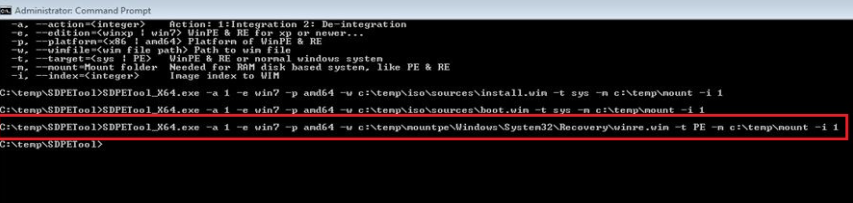
10. Using SDPETool to inject SD kernel drivers into winre.wim
C:\temp\SDPETool>SDPETool_X64.exe -a 1 -e win7 -p amd64 -w c:\temp\mountpe\Windows\System32\Recovery\winre.wim -t PE -m c:\temp\mount -i 1
11. Unmount winre.wim image and commit the change
C:\Program Files (x86)\Windows Kits\10\Tools\bin\i386>imagex.exe /unmount /commit c:\temp\mountpe
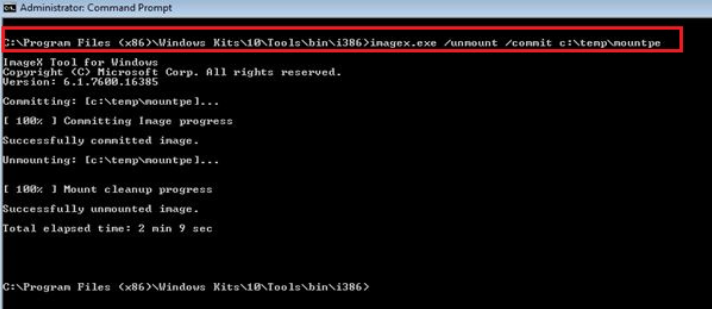
Expected output for ImageX tool for Windows below:
ImageX Tool for Windows
Copyright (C) Microsoft Corp. All rights reserved.
Version: 10.0.10011.0
Committing: [c:\temp\mountpe]...
[ 100% ] Committing Image progress
Successfully committed image.
Unmounting: [c:\temp\mountpe]...
[ 100% ] Mount cleanup progress
Successfully unmounted image.
Total elapsed time: 1 min 47 sec
12. Using oscdimg.exe tool to create an ISO image of modified OS
C:\temp>oscdimgamd64.exe -n -m -bc:\temp\iso\boot\etfsboot.com c:\temp\iso c:\temp\en_windows_10_enterprise_version_1511_x64_dvd_7224901.iso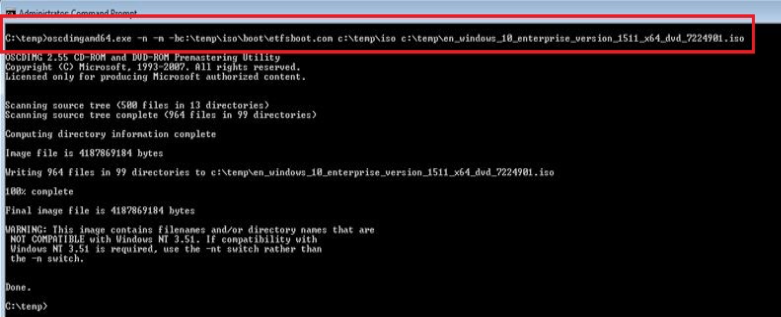
Expected output from OSCDIMG tool for Windows below:
OSCDIMG 2.56 CD-ROM and DVD-ROM Premastering Utility
Copyright (C) Microsoft, 1993-2012. All rights reserved.
Licensed only for producing Microsoft authorized content.
Scanning source tree (500 files in 13 directories)
Scanning source tree complete (959 files in 101 directories)
Computing directory information complete
Image file is 4293281792 bytes
Writing 959 files in 101 directories to c:\Windows10x64_Build10240_SDIntegrated_v7.1.iso
100% complete
Final image file is 4293281792 bytes
13. Done.
If there are any questions or concerns, please contact our Technical Support team.
Email: [email protected]
Phone: 1-888-879-5879 x 1
Internal Reference:
KB 1589 "How to Inject SD Kernel Modules Into Windows 10